


Lab Report: The Amaretti Sabotage: How my Orange Blossom Amaretti developed a split personality - cracked and fabulous on the outside but totally collapsed under pressure.
The Fix: The ingredient adjustments and mechanical trick that saved the recipe.
Even with a recipe calibrated for high-altitude, mountain physics plays by its own ruthless rules. This week we took our engineered Orange Blossom Amaretti into the lab. This wasn’t a lazy sea-level recipe — it was already adjusted for elevation. Yet the thin air still staged a complete structural coup.
This is the story of how a delicate recipe with few ingredients became a spectacular Fail. Here’s the forensic breakdown of what went wrong, the science behind the Fix, and the validated recipe that now succeeds for us Elevated Beings living from 5,000–7,500 feet.
A Note on the Mountain Lab Our research kitchen uses a baseline of 6,000 feet, but these invisible atmospheric forces don’t wait for a mountain peak. If your kitchen sits anywhere above 3,000 feet, your ingredients are already failing you.
What is a Traditional Amaretti? The traditional Italian Amaretti Morbidi is a historical pastry marvel. Unlike standard cookies, it contains zero flour and zero leaveners. Instead, it relies entirely on a fragile scaffolding of whipped egg whites folded into ground almonds and sugar.
When executed correctly, it bakes into an elegant, deeply crackled aromatic dome — gossamer crisp on the outside with an intensely chewy marzipan heart inside. At elevation, its entire structural architecture is held up by trapped air in delicate egg white foam that evaporates at a radically accelerated pace. This makes the Amaretti the ultimate litmus test for mountain physics.
The Crime Scene: 8 Points of The Fail - Our initial test run resulted in an overly sugary cookie that collapsed. When we isolated the variables, we found a brutal chain reaction:
The delicate aromatics of the orange blossom water completely vanished into the thin mountain air.
Extra orange blossom water added to rescue flavor made the dough far too wet.
Tangerine zest was introduced as an emergency flavor elevator.
Extra-large egg whites created excess water in the delicate foam matrix.
A frantic addition of raw almonds brought uncalculated moisture.
The fragile dough fell apart during shaping.
Rolling the weeping dough balls in powdered sugar became a messy, structurally destructive struggle.
In the oven, the powdered sugar shell split and the molten almond dough oozed out looking more like a marshmallow in an old-style women’s girdle than a luscious Amaretti Morbidi.
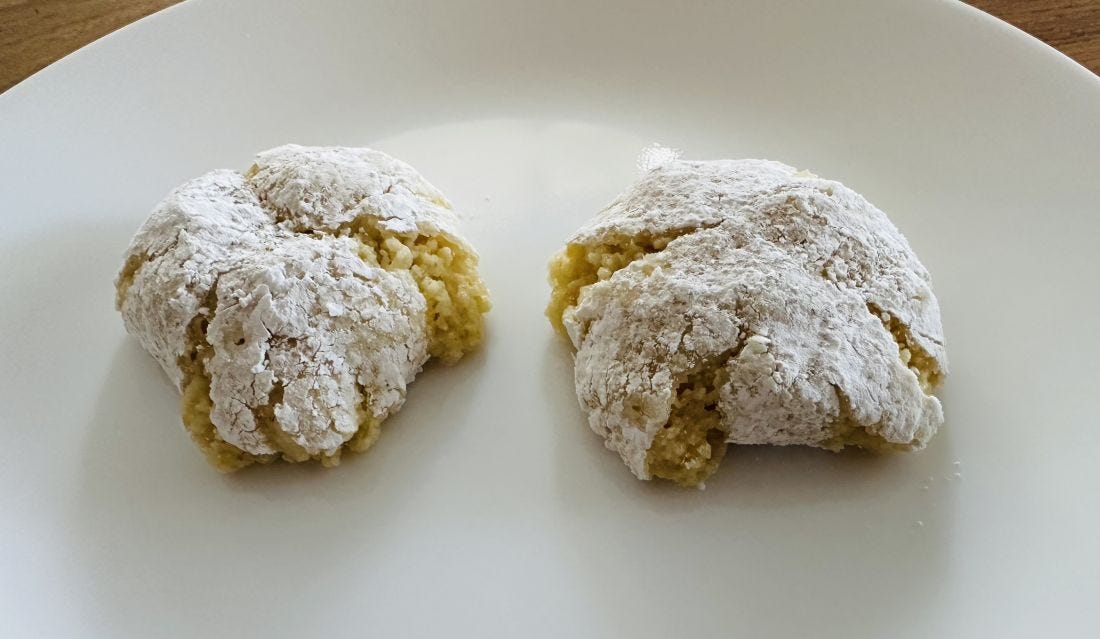
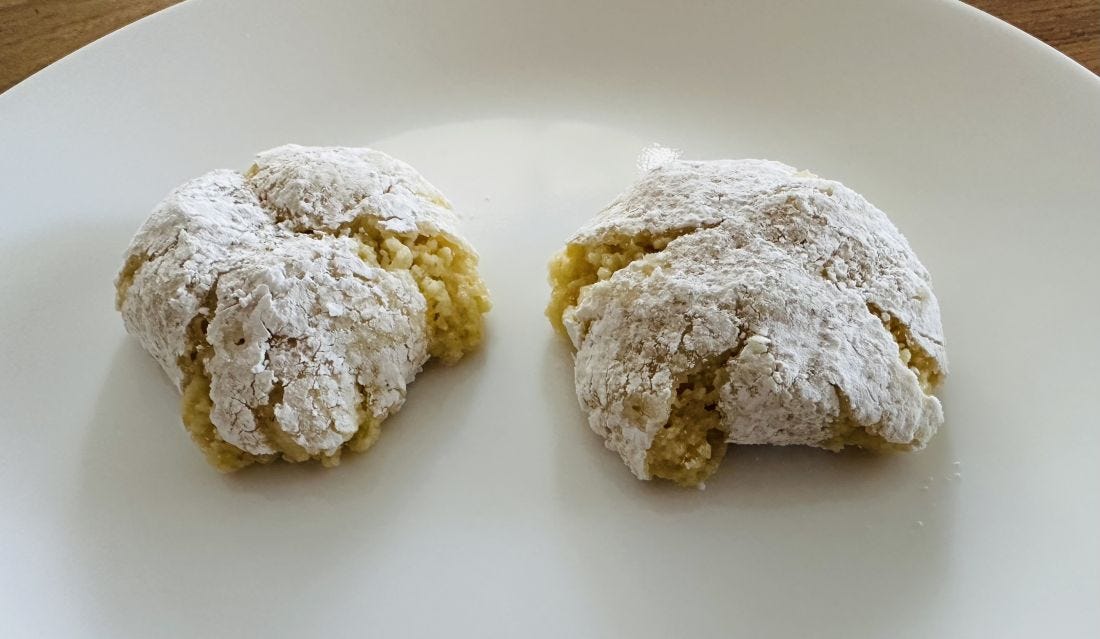
Engineering the Solution: The Fix - To rebuild the Amaretti scaffolding, we systematically adjusted the chemistry, scaffolding, and physical handling of the dough.
Changes from Traditional Sea Level Recipe to The Elevated Amaretti:
Granulated Sugar: Reduced from 150g to 100g → Prevents liquefaction
Ground Almonds: Increased from 200g to 280g → Better structural density
Egg Whites: Strictly 2 Large (60g) → Precise moisture control
Whipping: Stiff peaks instead of soft → Stronger foam at altitude
Orange Blossom Water: Increased to 2.0 tsp → Flavor survives thin air
Tangerine Zest: Added 1 tbsp → Anchors the floral notes
Salt: Increased to ¼ tsp → Cuts sweetness
The Breakthrough: Exposing the Hand-Rolling Myth If you look up any traditional Amaretti recipe online, the instructions always say the same thing: “Dust your hands with sugar and roll the dough into smooth balls between your palms.”
This advice is completely illogical at altitude. Egg whites are famously intolerant to lipids. The natural oils and radiant heat from your human hands immediately begin breaking down the fragile, over-expanding egg foam matrix on contact.
“At sea level your hands just annoy the meringue. At elevation, they commit structural homicide.”
The Kitchen Counter Rebellion At high elevation, hand-rolling a delicate nut-and-egg-white dough is physically impossible. Your skin oils and palm warmth act as immediate structural saboteurs.
Instead, we turned to a mechanical intervention: Use a spring-loaded cookie scoop. Pack the dough tightly and firmly into the scoop. Eject the packed dough ball directly into the confectioners’ sugar. By completely bypassing warm hands, the egg-white scaffolding stays perfectly cold, pristine, and oil-free.
The result of The Fix? The cookies rose beautifully in the oven, setting into gorgeous, deeply cracked, aromatic domes with the perfect crisp exterior and chewy marzipan center.
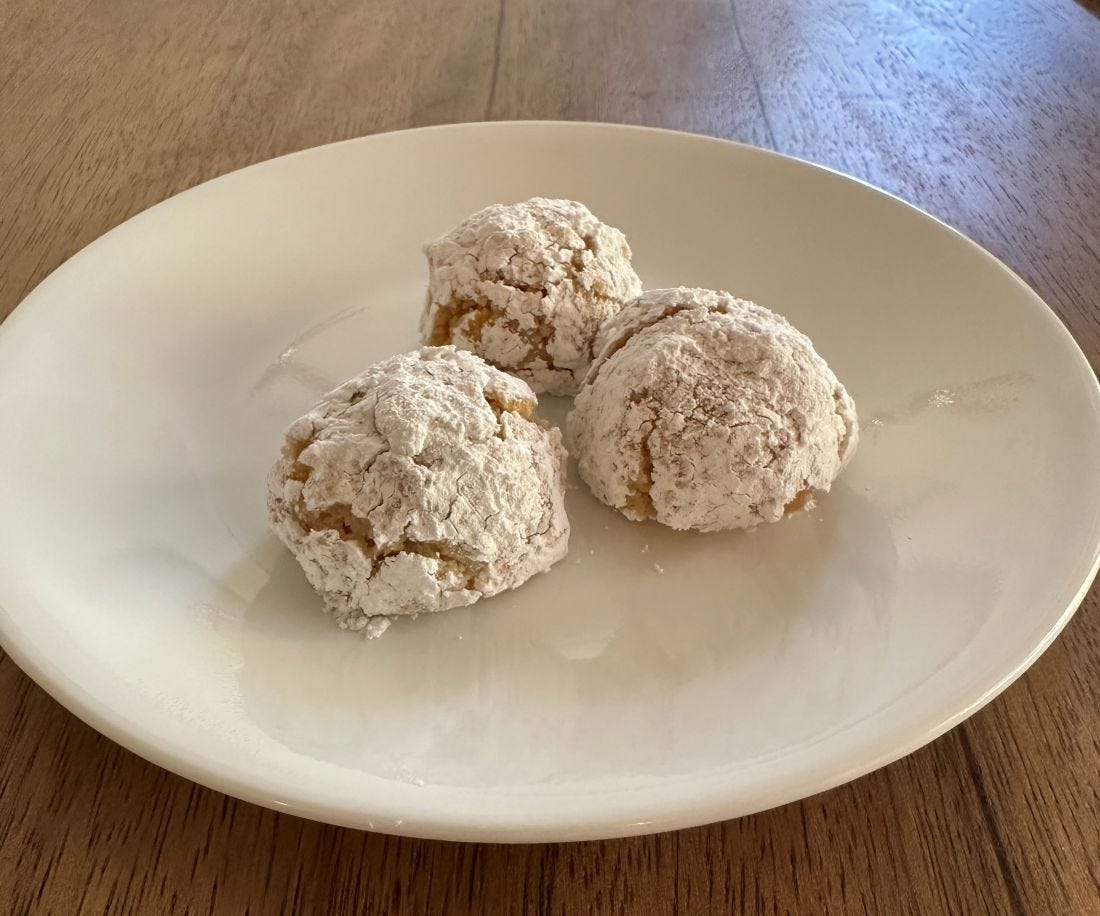
The Elevated Orange Blossom Amaretti (Morbidi Inspired)
Yield: ~24 cookies | Active Prep: 25 minutes | Bake Time: 12–15 minutes | Calibration: 3,000–7,500 feet
The Profile: These snow-dusted jewels hide a dense, chewy marzipan heart infused with delicate orange blossom. The texture is a study in contrast — shattering into a fragile, glass-like outer crust that gives way to a soft, pillowy center. The subtle floral notes of the orange blossom and the bright tangerine zest vibrate clearly against the almond intensity.
Ingredients
The Dry Ingredients
2 ¼ cups (280g) whole blanched skinless almonds
½ cup (100g) organic granulated sugar (to be divided per instructions)
¼ tsp (1.5g) fine sea salt
The Wet Ingredients & Aromatics
2 Large egg whites (strictly room temperature — avoid Extra Large)
1 tbsp tangerine zest (finely grated)
2 tsp pure orange blossom water
¼ tsp cream of tartar
1–3 tsp room temperature water (The “Rescue” liquid)
The Coating
½ cup (60g) powdered sugar
Preparation
The Light Toast & Rapid Cool Preheat your oven to 325°F. Toast the whole blanched almonds on a sheet pan for 5–7 minutes to drive off deep internal moisture. Immediately place the warm almonds into the freezer to speed up the cooling process. They must be cold before grinding to prevent the food processor blades from heating the nuts and drawing out heavy oils.
The Sugar-Shield & Pour-Back Grind Place the completely cooled almonds into your food processor along with 2 tablespoons (25g) of your weighed granulated sugar. Process using quick, short bursts. The sugar acts as a protective buffer to keep the nut meal perfectly fluffy. Pour the ground mixture completely out into a bowl, then pour it right back into the processor. Pulse again until the mixture is completely uniform and resembles coarse cornmeal.
The Floral Integration: Citrus Capture In a wide bowl, whisk the remaining 75g sugar, fine sea salt, tangerine zest, and orange blossom water directly into your ground almond meal. Rub the mixture together briskly through your fingers until the scent is completely uniform and the volatile citrus oils are securely captured by the sugar matrix.
The High-Tension Loft In a separate, pristine, grease-free bowl, beat your 2 Large egg whites and ¼ tsp cream of tartar on high speed until strict stiff peaks form. They should be completely firm and stand upright when the whisk is lifted.
The Incorporation: Sculpting Consistency Gently fold your prepared aromatic almond mixture into the whipped egg whites using a rubber spatula until it forms a uniform dough that feels like stiff sculpting clay.
The Tight-Pack Scoop & Roll: Bypass Your Palms Preheat your oven to 345°F and line a heavy baking sheet with clean parchment paper.
Do not attempt to roll this dough between your hands — your natural skin heat and lipids will cause the foam structure to collapse.
Use a 1-tablespoon cookie scoop to portion out the dough (approx. 20g mounds). Pack the dough tightly into the scoop against the bowl. Eject the packed mound directly into your bowl of powdered sugar. Roll once, let it sit quietly in the sugar for 30 seconds, then roll it a second time. Space the mounds 1.5 inches apart.
The 345°F Bake & Set Slide the tray into the oven at 345°F. Do not open the oven door during the first 9 minutes of baking to avoid a sudden barometric pressure-drop collapse. Bake for 12–15 minutes. The Pillow Test: Gently press the side of a cookie. It should register a fragile, glass-like snap on the surface but have a soft, pillowy give in the center.
Slide the parchment sheet with the hot cookies directly onto a wire rack and let them cool for 15–20 minutes to allow the interior marzipan heart to firmly set.
Consume: These Amaretti have risen from the ashes of the Great Girdle Ooze. They are now structurally sound, deeply cracked, and dangerously addictive. Eat them slowly and savor the hard-won mountain victory. You’re welcome.
The Forensic Pairing: “The Obsidian Blossom” Serve these historical, snow-dusted jewels alongside our Midnight Obsidian Sea Salt Parfait Glacé. The sharp salt in the dark, rich parfait enhances the depth of the cocoa elements, creating a highly sophisticated flavor bridge for the floral orange blossom and bright tangerine top-notes of the cookie.
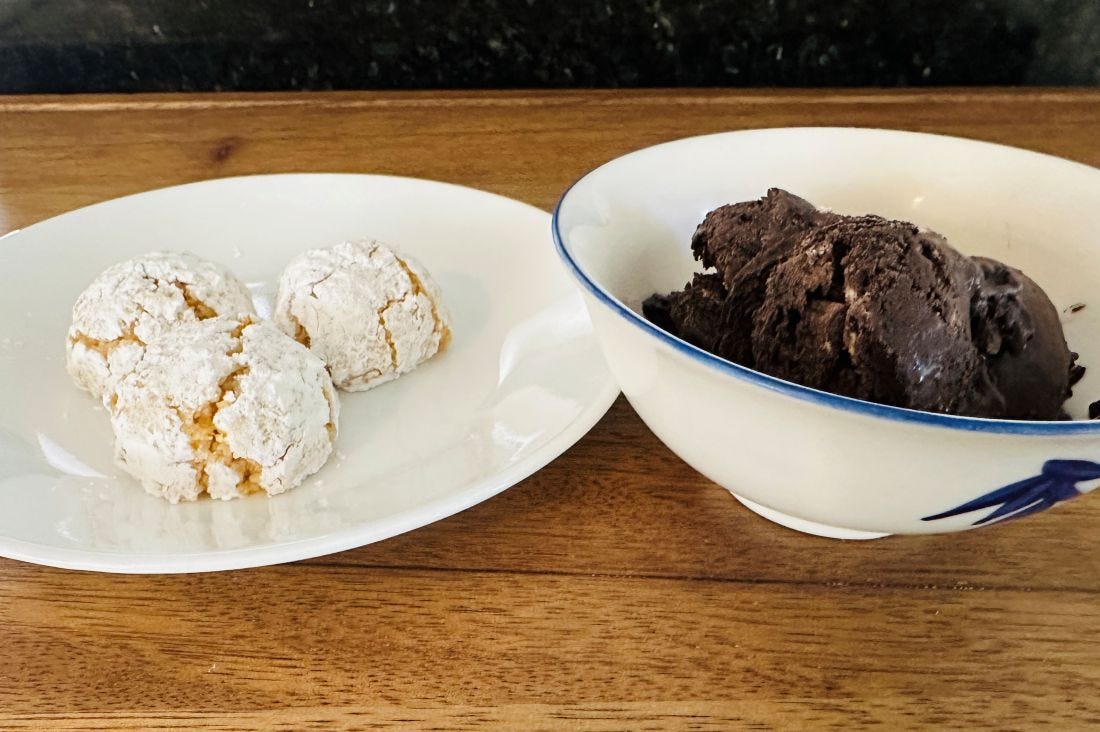
In our upcoming weekly Lab Reports, we are going to continue isolating these mountain crime scenes one by one. I’ll provide you with the hard data, the exact science, and the validated artisan formulas required to outsmart the physics and bring true luxury - and a healthy hit of dopamine - back to your mountain kitchen.
Stay tuned, and for the love of all that is structurally sound - keep your greasy little saboteurs off the egg whites.
With Forensic Love,
Freddie
The Research Baker