


Even with years of high-altitude baking under my belt, some recipes still fight dirty. This time it was the Bergamot & Lavender Sablé - a delicate French butter cookie that is supposed to deliver a crisp sandy edge, a tender melt-in-your-mouth center, and a beautiful wave of floral-citrus aromatics.
Instead, it took many painful failures before I achieved elevated success. The Elevated Recipe below.
The Sensory Blueprint: Why Your Brain Refuses to Taste a Grey Cookie
Before you even take a bite, your nervous system has already decided how something will taste. Most of us think flavor lives on the tongue. Biology says otherwise.
1. The Visual Filter: Your Eyes Eat First Human evolution has hardwired our brains to use visual cues as an immediate safety check. Before a cookie ever touches your lips, your visual cortex instantly tells your stomach what to expect.
If a cookie is called “Bergamot Lavender” but looks like a dull, muddy grey rain cloud, your brain panics. Grey = decay, stones, or “probably not food.” This visual bias actively tricks your palate into tasting something muddy and uninspired - even if you’ve packed the dough with beautiful aromatics.
2. The Nose-Tongue Connection Your tongue is actually pretty basic - it can only detect sweet, salty, bitter, sour, and umami. It has no clue what bergamot or lavender is supposed to taste like.
Here’s where it gets weird:
The real magic happens through retronasal olfaction - science’s fancy term for smelling through the back of your mouth.
Your tongue? Just the puppet. Smell is the puppet master, yanking the strings straight up the back of your throat.
Disturbing, right?
When you chew, the warmth of your mouth releases scent molecules that travel up the back of your throat to your nose. Your brain combines those aromas with the basic signals from your tongue to create what we call “flavor.”
At high altitude, low pressure literally steals those volatile aromatics during baking. No scent molecules = no flavor. You’re left with a sad, sweet, fatty lump that tastes like expensive cardboard.
After five (okay, six) increasingly ridiculous failures involving lawn clippings, flavor heist, butter bullies, hair-dye disasters, and Victorian guest soap, I finally sat down and treated the recipe like a crime scene.
Here’s exactly where things went wrong - and how we caught every culprit.
The Crime Scene: 6 Petty Crimes Against Pastry
When we isolated the variables behind our initial test batches, we uncovered an interconnected web of sensory and aesthetic sabotage:
Fail 1: The Unwashed Lawn Effect Whole dried lavender buds left bitter, woody “soapy chunks” in the crumb - charming little surprises that made the pastry taste less like fine baking and more like I was chewing on unwashed lawn clippings. Very “herbal.” Very “earthy.” And very much a crime against Sablé.
Fail 2: The Volatile Flavor Escape The delicate aromatics of the bergamot and lavender completely evaporated into the low-pressure atmosphere during the bake, turning an elegant French pastry into a beautiful lie wrapped in butter. It looked sophisticated. It tasted like disappointment wearing lipstick.
Fail 3: The Bully Flavor Block Utilizing premium, deeply golden European cultured butter created an immediate taste barrier. While European butter has it’s place in the cookie world, the aggressive dairy profile acted as an aromatic bully - classic European butter behavior: loud, expensive, and refusing to share the spotlight.
Fail 4: The Rain Cloud Slate That same deep yellow butter fat hit our purple food gel on the color wheel and caused a disastrous optical reaction, instantly staining the dough a sad, muddy concrete gray - because of course that bully wasn’t satisfied with just dominating the flavor. It went full chaos mode and murdered the color too.
Fail 5: The Purple Panic Attack Desperate to fix the grey dough, I poured in extra purple food gel, then panicked and added blue. The result was a cursed dull lavender-gray that looked exactly like my Grand Aunt Hilda’s infamous at-home hair dye job. It wasn’t purple - it was “what happened in 1997 and we don’t talk about it anymore.”
Fail 6: The Victorian Guest Soap Effect Trying to overcome the high-altitude flavor loss, I added extra bergamot oil straight into the lavender dough. The result was concentrated hot spots that tasted exactly like licking a fancy Victorian lavender guest soap — 90% perfume, 10% regret.
Engineering the Solution: 6 Forensic Fixes
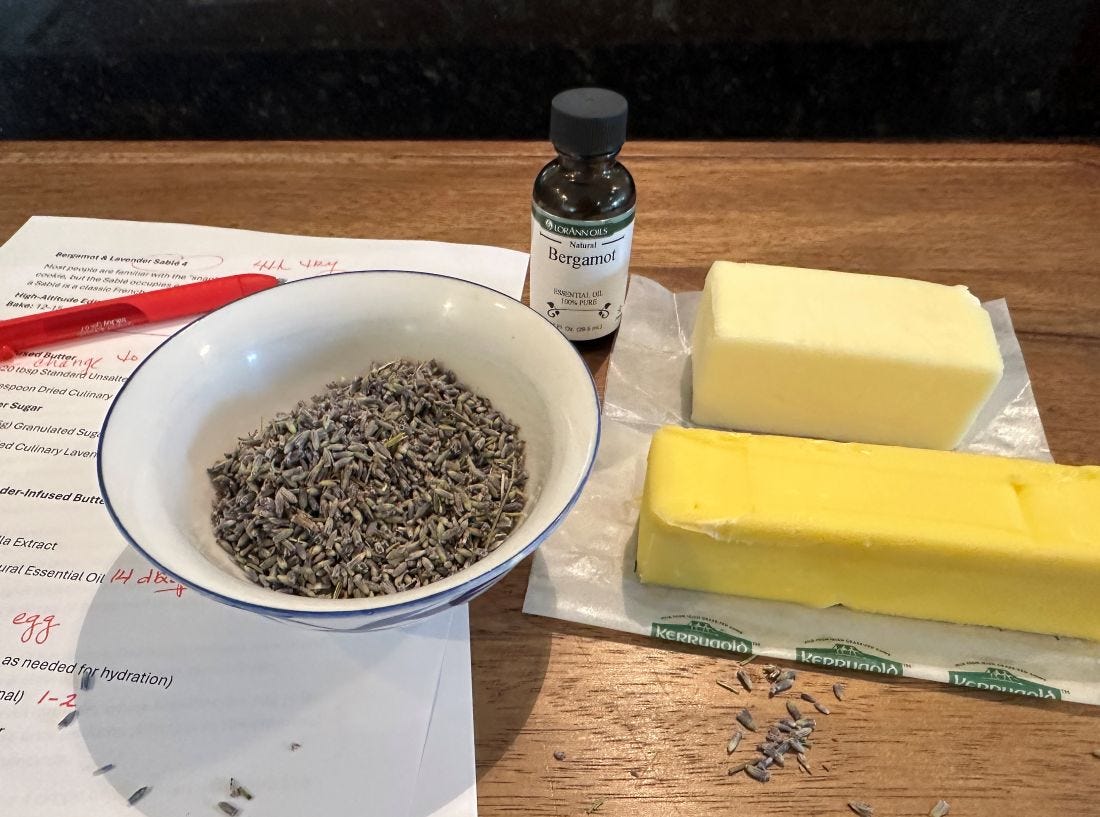
To stop the botanical heist and establish a pristine visual canvas, we systematically re-engineered our recipe to answer each point of failure directly:
Fix 1: Sugar vs. The Woody Criminals To eliminate the woody chunks while keeping a sophisticated aesthetic, we stopped the high-speed grinding altogether. We abandoned the old method of pulverizing the buds with sugar because it made no difference in elevating the taste. Instead, we limited the food processor to just 1 to 2 gentle pulses with a small portion of the lavender and the citric acid. This safely cracked the buds into tiny, beautiful specks to give the dough its signature artisan look and the citric acid balanced the floral notes. By the way, citric acid is easy to find and very cheap. You need just 1/16 – 1/8 tsp to enhance flavors.
Fix 2: Fat Hostage Negotiation To halt the volatile flavor escape, we melted our butter and steeped the lavender buds directly into the hot liquid, trapping the perfumes at a molecular level. By straining out the lavender buds, we completely trapped the flavor oils while permanently discarding the remaining raw lavender “lawn”. We then whipped the liquid fat over an ice bath for 3 minutes until it re-emulsified so it could still cream properly for the sablé.
Fix 3: The Butter Coup We completely banned European cultured butter from this recipe. Switching to standard unsalted butter removed the dominating dairy notes and finally let the delicate botanicals breathe.
Fix 4: Banishing the Yellow Menace This also replaced the deep yellow butter with standard pale butter, instantly removing the color-ruining villain and preventing muddy gray disasters.
Fix 5: The Great Starch Whitening We introduced 30g (¼ cup) of cornstarch into the dry ingredients. Its bright-white opacity acted as a molecular bleach, creating a pristine white-and-cream canvas. This let us ditch the chaotic food dye madness and use just 1 - 2 disciplined drops of purple gel for a beautiful, elegant lilac tint.
Fix 6: The Soap Shield To safely maximize our bergamot without creating chemical hot spots, we increased it to 12–14 drops, but locked it down with ⅛ tsp of citric acid in the lavender sugar. The citric acid brightened the fruit notes and kept everything clean, floral, and mercifully soap-free.
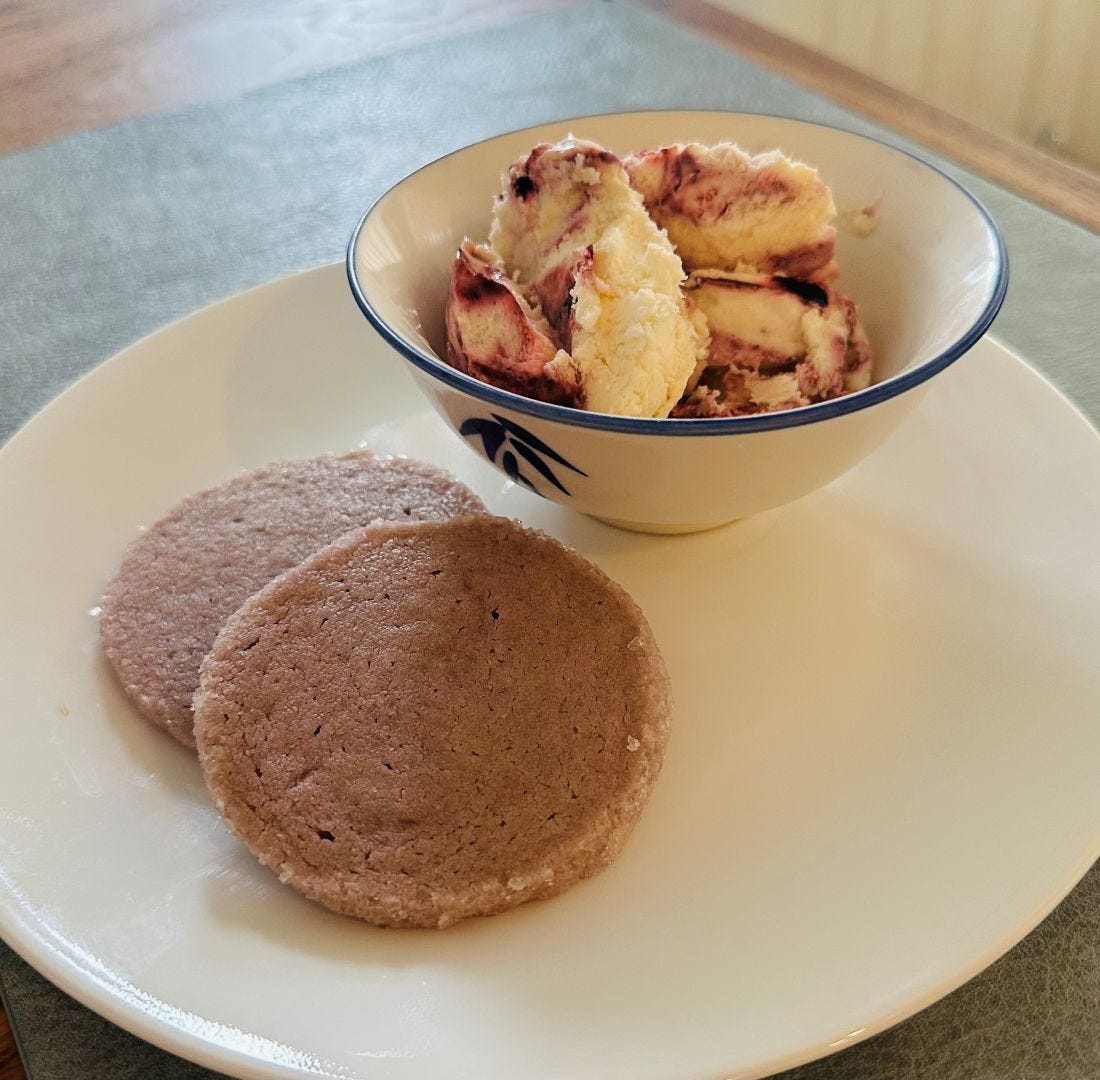
Post-Lab Conclusion
When you snap a finished Sablé in half, the crumb should break like dry sand and melt away on your tongue. After six disasters, we finally cracked the code: a neutral starch canvas and a smart fat shield that locks in every last drop of bergamot and lavender.
The result? Pastries that actually taste like the elegant floral dream we were chasing — instead of lawn clippings, butter bullies, or Victorian guest soap.
Be sure to package them in an airtight container the moment they hit room temperature. Your lipid shield may have won the oven battle, but the low barometric pressure on your counter is still out there trying to commit petty theft.
Enjoy them while they’re perfect.
Stay tuned… and for the love of all things violet, don’t panic-pour the food gel.
With Forensic Precision,
Freddie
The Research Baker
Bergamot & Lavender Sablé
Most people are familiar with the “snap” of a ginger snap or the “chew” of a chocolate chip cookie, but the Sablé occupies a world of its own. Named after the French word for “sand,” a Sablé is a classic French round butter cookie defined by its delicate, crumbly texture.
Yields: Approx. 30 - 36 cookies | Prep: 45 mins | Chill: 24 hours | Bake: 12–15 mins | 5,000 - 7,500 elevation
Ingredients
For the Infused Butter
21 tbsp (269g) unsalted Butter, not European (yields 18 tbsp (255g) after straining)
1 Tablespoons Dried Culinary Lavender Buds
For the Lavender Sugar
2/3 cup (135g) Granulated Sugar
2 Teaspoons Dried Culinary Lavender Buds
1/8 tsp citric acid (cheap and easy to find near the canning jars at the grocery store, explained further below)
For the Creaming Stage
18 tbsp (255g) Lavender-Infused Butter (Reconstructed to 64°F–67°F)
1 ¾ tsp Table Salt
2 tsp Nielsen-Massey Vanilla Extract
12 – 14 drops LorAnn Bergamot Natural Essential Oil
For the Binder
1 Extra Large Egg Yolk
1 Tablespoon Heavy Cream (plus more as needed for hydration)
1-2 drops Purple Food Gel
Dough
¼ cup (30g) Cornstarch
2 ½ cups (300g) All-Purpose Flour
For the Finishing Touch
¼ cup Sparkling Sugar (for the edge)
Preparation
The Infusion: Melt the butter over low heat until it just begins to foam. Add 1 tablespoon of lavender buds, remove from heat, cover, and steep for 20 minutes.
Fat is the ultimate carrier for flavor. By heating the butter, you are pulling the essential oils directly from the lavender and binding them to the fat. This ensures a foundational flavor that coats the entire palate.
The Reconstruction: Strain the butter through a fine-mesh sieve into a stainless steel bowl, pressing the buds to extract all fat. Place the bowl in an ice-water bath. Stir constantly with a flexible spatula until the butter re-emulsifies and reaches the consistency of soft mayonnaise. This happens quickly in about 3 minutes. With an instant read thermometer check the temperature, you want the infused butter to be around 62°F–63°F before you cream it with your other ingredients. If necessary, put the butter in the fridge for a few minutes.
Melting butter breaks the emulsion; the ice bath and constant whisking forces the milk solids and water back into a uniform state. This allows the butter to cream properly with the sugar in Step 4.
3. Lavender Sugar: Combine granulated sugar, citric acid and 1 teaspoons of lavender buds in a small food processor. Process just until lavender breaks into smaller pieces, 1 -2 pulses. Process 1 tsp separately to get the look in the cookie.
Don’t let the chemical name citric acid intimidate you, is dirt cheap and sitting right in the canning aisle of your local grocery store. Lavender can be bitter, perfumey, or soapy. By introducing a mere 1/8 tsp of citric acid, it chemically brightens the flavor, turning down the “soap volume” and morphing it into a clean, crisp botanical top-note that highlights the citrus notes of the bergamot.
4. Creaming: In a medium bowl, beat together the reconstructed lavender butter, lavender sugar, salt, vanilla, and 12 - 14 drops of bergamot oil until smooth and creamy (approx. 3 minutes).
Keep total control over the bergamot, carefully drip the oil into a separate spoon away from your bowl. This allows you to count the drops precisely and prevents a “glug” from ruining your batch. One extra drop is the difference between a wonderful artisanal cookie and eating a bar of Victorian guest bathroom soap.
5. The Color Emulsion & Binder: In a small ramekin, whisk together the heavy cream, and purple food gel. Whisk until uniform. Add this to the creamed butter along with the egg yolk and beat on low speed for 30–60 seconds.
Sadly, dried lavender buds are an inelegant brown-grey. We add a bit of color here because the brain needs this cookie to look like lavender for our mouth to taste the full flavor and our nose to enjoy the aroma.
6. Flour & Starch: Whisk the cornstarch and flour together, then add to the bowl all at once. Fold by hand until the dough looks like damp sand and has no white streaks. Don’t overmix. Take a handful of dough and squeeze firmly. If it feels brittle or shaggy, stir in additional heavy cream 1 teaspoon at a time until the dough forms a solid, cohesive clump.
7. Shape & Chill: Divide into two 2-inch diameter logs about 5 inches long. Wrap in parchment and refrigerate for 2 hours.
The 2-inch diameter is the ideal “sweet spot” for a Sablé cookie to achieve a crisp outer edge and a soft, buttery center.
The Sparkling Rim: Roll the firm logs in Sparkling Sugar, pressing firmly.
The Cure: Re-wrap and refrigerate overnight. This allows the flavor molecules to fully “marry.”
Bake: Preheat to 350°F. Slice into 1/4-inch rounds, flash-freeze for 10 minutes, and bake for 12–15 minutes until edges are set but the center remains matte.
Consume: With zero restraint. You’ve just baked a sophisticated lavender sablé that actually tastes like lavender instead of a perfumed candle.
Warning: Enjoy them soon - before the dry mountain air turns your beautiful lavender sablés into elegant cookies that only vaguely remember their floral past.
Paired with Honeyed Blackberry Swirl Gelato.